


Stylus Phantasticus
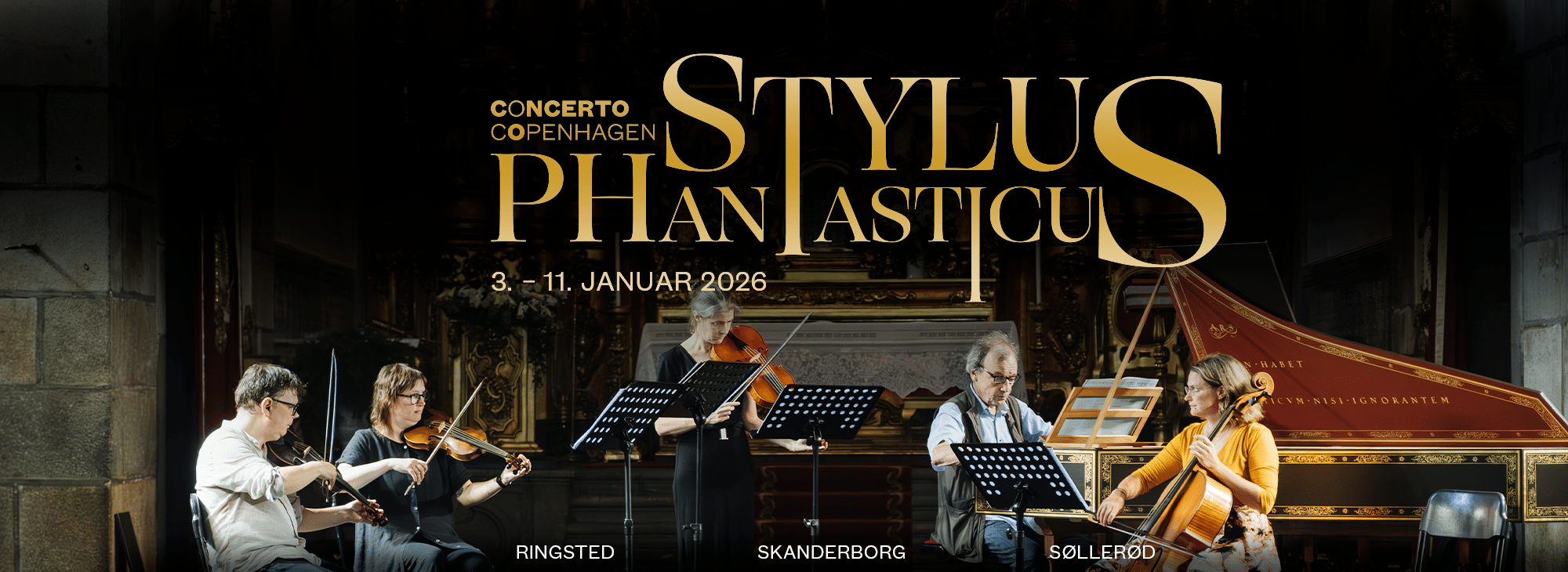
The most imaginative, unconventional, and vibrant form of expression of its time. Like a written improvisation, Concerto Copenhagen will bring the music to life as if it were composed yesterday and performed for the first time today.
“A kind of speech in music” is how Lars Ulrik Mortensen describes the stylus phantasticus, emphasizing that this music must be performed “so that it can surprise or shock and take the audience on a journey,” and that its performance must and should “go right to the edge—and at times beyond it.” The evening’s program offers such lavish examples of the free imagination of that era that it gives the concept of “Baroque music” entirely new dimensions.
The fanciful style, or in Latin “stylus phantasticus,” emerged in Italy in the late 16th century, often in virtuoso solo pieces for keyboard instruments known as “toccata” or “stravaganza,” and reached its peak with the North German organ school and Dietrich Buxtehude around 1700. In essence, it was the most unrestrained and wildly expansive form of expression of its time—whims, inventions, fancies, and caprices could alternate unpredictably—as if it were a written-down improvisation. Theorists of the time described the style as bound by neither melody, text, time signature, nor tempo; it can leap freely from idea to idea, and it gives a brilliant composer or musician the greatest possible leeway to stir the listener’s passions!
The concept of “Stylus phantasticus” may have faded with the Baroque era, but the free, playful musical form did not disappear. It found new paths and expressions in composers such as Mozart and Beethoven, both of whom were formidable improvisers, and not least in even later composers such as Chopin, Liszt, and Paganini. And striking a balance between spontaneous musical impulses and carefully conceived, complex structures and forms has been a constant challenge and a source of both frustration and inspiration for composers throughout the ages.
Concerto Copenhagen will bring the music of this era to life, as if it were written yesterday and performed for the first time today.
The most imaginative, unconventional, and vibrant form of expression of its time. Like a written improvisation, Concerto Copenhagen will bring the music to life as if it were composed yesterday and performed for the first time today.
“A kind of speech in music” is how Lars Ulrik Mortensen describes the stylus phantasticus, emphasizing that this music must be performed “so that it can surprise or shock and take the audience on a journey,” and that its performance must and should “go right to the edge—and at times beyond it.” The evening’s program offers such lavish examples of the free imagination of that era that it gives the concept of “Baroque music” entirely new dimensions.
The fanciful style, or in Latin “stylus phantasticus,” emerged in Italy in the late 16th century, often in virtuoso solo pieces for keyboard instruments known as “toccata” or “stravaganza,” and reached its peak with the North German organ school and Dietrich Buxtehude around 1700. In essence, it was the most unrestrained and wildly expansive form of expression of its time—whims, inventions, fancies, and caprices could alternate unpredictably—as if it were a written-down improvisation. Theorists of the time described the style as bound by neither melody, text, time signature, nor tempo; it can leap freely from idea to idea, and it gives a brilliant composer or musician the greatest possible leeway to stir the listener’s passions!
The concept of “Stylus phantasticus” may have faded with the Baroque era, but the free, playful musical form did not disappear. It found new paths and expressions in composers such as Mozart and Beethoven, both of whom were formidable improvisers, and not least in even later composers such as Chopin, Liszt, and Paganini. And striking a balance between spontaneous musical impulses and carefully conceived, complex structures and forms has been a constant challenge and a source of both frustration and inspiration for composers throughout the ages.
Concerto Copenhagen will bring the music of this era to life, as if it were written yesterday and performed for the first time today.
PROGRAM
Heinrich I.F. Biber: Sonata No. 8 from *Fidicinium Sacro-Profanum*
Dario Castello: Sonata No. 15 for 4 (Book II)
Johann H. Schmelzer: Lament of Ferdinand III
Johann J. Froberger: Toccata Seconda for solo harpsichord
Henry Purcell: Pavane in A major, Z.748
Antonio Bertali: Ciacona for violin and continuo
– Break –
Heinrich I.F. Biber: Sonata XI from *Fidicinium Sacro-Profanum*
Dietrich Buxtehude: Toccata in G minor for solo harpsichord, BuxVW 163
Johann H. Schmelzer: Polish Bagpipes
Johann Pachelbel: Canon & Gigue
CONCERTS
No events found for this series.